1. Introduction
Java provides the java.util.concurrent package since 1.5 to support parallel execution. It improves the performance when dealing with a time consuming task. The java.util.concurrent.FutureTask class provides a base implementation of the java.util.concurrent.Future interface. The following class diagram outlines FutureTask and its relationship with Callable, Runnable, Future, Executor, and ExecutorService.
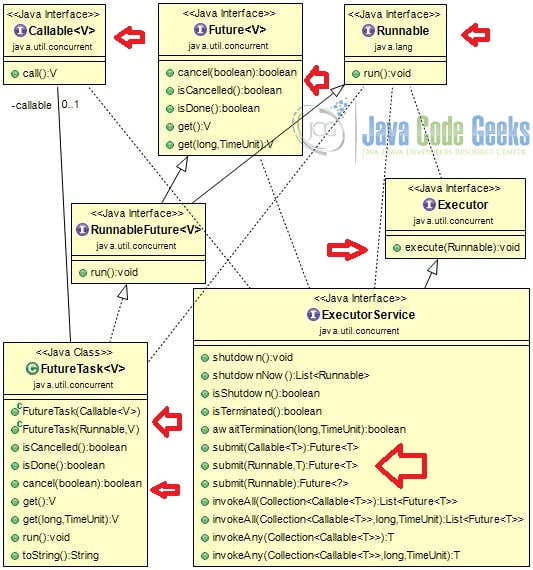
In this example, I will demonstrate the following:
- How to create a FutureTask object from a Callable Task
- How to create a FutureTask object from a Runable Task
- How to run tasks parallel
- How to cancel a FutureTask
2. Technologies Used
The example code in this article was built and run using:
- Java 11
- Maven 3.3.9
- Eclipse Oxygen
3. Maven Project
3.1 Dependencies
No any dependencies needed.
pom.xml
<project xmlns="http://maven.apache.org/POM/4.0.0"
	xmlns:xsi="http://www.w3.org/2001/XMLSchema-instance"
	xsi:schemaLocation="http://maven.apache.org/POM/4.0.0 http://maven.apache.org/xsd/maven-4.0.0.xsd">
	<modelVersion>4.0.0</modelVersion>
	<groupId>com.jcg.example</groupId>
	<artifactId>FutureTask-example-code</artifactId>
	<packaging>jar</packaging>
	<version>1.0</version>
	<name>FutureTask Example Code</name>
	<build>
		<sourceDirectory>src</sourceDirectory>
		<plugins>
			<plugin>
				<artifactId>maven-compiler-plugin</artifactId>
				<version>3.8.0</version>
				<configuration>
					<release>11</release>
				</configuration>
			</plugin>
		</plugins>
	</build>
</project>
3.2 Count Service
In this step, I will create a CountService which has one method – countNumberOfDivisble(long firstNumber, long lastNumber, long divisor) method. It returns the number of multiples of divisor between firstNumber and lastNumber.
CountService.java
package org.jcg.zheng;

public class CountService {
	/**
	 * Count number of divisible.
	 *
	 * Returns the count of numbers that can be divided by the divisor without
	 * remainder.
	 *
	 * @param firstNumber the start number
	 * @param lastNumber  the finish number
	 * @param divisor     the divisor
	 * @return the count of these numbers which can be divisible by the divisor from
	 *         firstNumber to the lastNumber
	 */
	public long countNumberOfDivisible(long firstNumber, long lastNumber, long divisor) {
		long count = 0;

		for (long i = firstNumber; i <= lastNumber; i++) {
			if (i % divisor == 0) {
				count++;
			}
		}

		return count;
	}
}
3.3 Count Task Data
In this step, I will create a CountTaskData which defines the following data members:
beginNumber– for beginning number.endNumber– for ending number.DIVISOR– constant with value of 3.MAX_NUMBER– constant with value of 30,000,000,001.createTwoTasks()– create twoCountTaskDataobjects. The first starts from 0 to the middle of the max number. The second starts from the middle and ends at the max number. I will use it later to count the multiples of 3 from 0 to 30,000,000,001 concurrently.
CountTaskData.java
package org.jcg.zheng;

import java.util.ArrayList;
import java.util.List;

public class CountTaskData {

	// DIVISOR to be used in calculation
	public static final long DIVISOR = 3;

	// Maximum number to check
	public static final long MAX_NUMBER = 3000000000l;

	public static List<CountTaskData> createTwoTasks() {
		List<CountTaskData> tasks = new ArrayList<>();

		tasks.add(new CountTaskData(0, MAX_NUMBER / 2));
		tasks.add(new CountTaskData(MAX_NUMBER / 2 + 1, MAX_NUMBER));

		return tasks;
	}

	private long beginNumber;
	private long endNumber;

	public CountTaskData(long beginNumber, long endNumber) {
		super();
		this.beginNumber = beginNumber;
		this.endNumber = endNumber;
	}

	public long getBeginNumber() {
		return beginNumber;
	}

	public long getEndNumber() {
		return endNumber;
	}
}
3.4 Callable Count Task
In this step, I will create a CallableCountTask class which implements Callable and returns a Long value.
CallableCountTask– constructor to create an object.call()– invokescountService.countNumerOfDivisible() and returns the counts.
CallableCountTask.java
package org.jcg.zheng.concurrent;

import java.util.concurrent.Callable;

import org.jcg.zheng.CountService;

public class CallableCountTask implements Callable<Long> {

	private CountService cutService = new CountService();
	private long divisor;
	private long first;
	private long last;

	public CallableCountTask(long first, long last, long divisor) {
		this.first = first;
		this.last = last;
		this.divisor = divisor;
	}

	@Override
	public Long call() throws Exception {
		System.out.println(Thread.currentThread().getName() + " call starts.");
		long ret = countService.countNumberOfDivisible(first, last, divisor);
		System.out.println(Thread.currentThread().getName() + " call ends.");
		return ret;
	}

}
3.5 RunnableTask
In this step, I will create a RunnableTask class which implements Runnable and doesn’t return anything.
run()– sleeps for a given period, catchesjava.lang.InterruptedExceptionand prints out a message.
RunnableTask.java
package org.jcg.zheng.concurrent;

public class RunnableTask implements Runnable {

	// use this to illustrate a long running task
	private long sleepMills;

	public RunnableTask(long sleepMills) {
		super();
		this.sleepMills = sleepMills;
	}

	@Override
	public void run() {
		try {
			System.out.println(Thread.currentThread().getName() + " run starts.");
			Thread.sleep(sleepMills);
                        System.out.println(Thread.currentThread().getName() + " run ends.");
		} catch (InterruptedException e) {
			System.out.println(Thread.currentThread().getName() + " interrupted.");
		}

	}

}
4. Demo
4.1 Sequential Execution Demo
In this step, I will create a SequentialExecutionDemo class which finds the number of multiples of 3 between 0 and 30,000,000,001.
SequentialExecutionDemo.java
package org.jcg.zheng.concurrent;

import java.time.Duration;
import java.time.Instant;

import org.jcg.zheng.CountService;
import org.jcg.zheng.CountTaskData;

public class SequentialExecutionDemo {
	public static void main(String[] args) {
		// Completed in 46805 ms.
		Instant begin = Instant.now();
		long counts = (new CountService()).countNumberOfDivisible(0, CountTaskData.MAX_NUMBER, CountTaskData.DIVISOR);

		Instant end = Instant.now();
		System.out.println("Result: " + counts + " time=" + Duration.between(begin, end).toMillis() + " ms.");
	}

}
Execute it as a Java application and capture the output here.
C:\MaryZheng\Workspaces\jcg-FutureTask-example\target\classes>java org.jcg.zheng.concurrent.SequentialExecutionDemo
Result: 1000000001 time=47471 ms.
As you seen here, it took about 47 seconds to complete.
4.2 Parallel Execution Demo
In this step, I will create a ParallelExecutionDemo class which finds the number of multiples of 3 between 0 and 30,000,000,001 with two parallel tasks. Here are the main steps:
- Create a two-thread pool with java.util.concurrent.Executors.
- Create two
FutureTaskobjects withCallableCountTask. - Submit or execute the
FutureTask. - Get the
FutureTaskresult. - Combine two
FutureTask‘s results.
In this step, I will demonstrate with three different methods:
executeViaFutureTask() – creates twoFutureTasks withCallableCountTask. InvokingExecutorService‘sexecute() method.submitViaFutureTask() — creates twoFutureTaskswithCallableCountTask. Invoking ExecutorService’ssubmit()method.submitViaCallableTask() – Using ExecutorService’s’s submit() method and usesFutureto get the result. This is to show the difference betweenFutureandFutureTask.
ParallelExecutionDemo.java
package org.jcg.zheng.concurrent;

import java.time.Duration;
import java.time.Instant;
import java.util.ArrayList;
import java.util.List;
import java.util.concurrent.ExecutionException;
import java.util.concurrent.ExecutorService;
import java.util.concurrent.Executors;
import java.util.concurrent.Future;
import java.util.concurrent.FutureTask;

import org.jcg.zheng.CountTaskData;

public class ParallelExecutionDemo {

	public static void main(String[] args) {
		Instant begin = Instant.now();
		System.out.println("Starting parallel execution ....");

		// Create a new ExecutorService with 2 thread to execute and store the Futures
		ExecutorService executor = Executors.newFixedThreadPool(2);
		List<FutureTask<Long>> tasks = new ArrayList<>();

		long resultFuture = 0;
		switch (args[0]) {
		case "executeViaFutureTask":
			resultFuture = executeViaFutureTask(executor, tasks);
			break;
		case "submitViaFutureTask":
			resultFuture = submitViaFutureTask(executor, tasks);
			break;
		case "submitViaCallableTask":
			resultFuture = submitViaCallableTask(executor);
			break;
		}

		// Shutdown the ExecutorService
		executor.shutdown();
		Instant end = Instant.now();

		System.out.println(
				"Result (Future): " + resultFuture + " time= " + Duration.between(begin, end).toMillis() + " ms");

	}

	/**
	 * Result (Future): 1000000001 time= 45612 ms Result (Future): 1000000001 time=
	 * 35592 ms
	 */
	private static long executeViaFutureTask(ExecutorService executor, List<FutureTask<Long>> tasks) {
		for (CountTaskData td : CountTaskData.createTwoTasks()) {
			FutureTask<Long> futureTask = new FutureTask<>(
					new CallableCountTask(td.getBeginNumber(), td.getEndNumber(), CountTaskData.DIVISOR));
			tasks.add(futureTask);
			executor.execute(futureTask);
		}

		return getConcurrentResult(tasks);
	}

	/**
	 * Result (Future): 1000000001 time= 33320 ms
	 */
	private static long submitViaFutureTask(ExecutorService executor, List<FutureTask<Long>> tasks) {
		for (CountTaskData td : CountTaskData.createTwoTasks()) {
			FutureTask<Long> futureTask = new FutureTask<>(
					new CallableCountTask(td.getBeginNumber(), td.getEndNumber(), CountTaskData.DIVISOR));
			tasks.add(futureTask);
			executor.submit(futureTask);
		}

		return getConcurrentResult(tasks);
	}

	private static long getConcurrentResult(List<FutureTask<Long>> tasks) {
		long resultFuture = 0;

		// Wait until all results are available and combine them at the same time
		for (FutureTask<Long> futureTask : tasks) {
			try {
				resultFuture += futureTask.get();
			} catch (InterruptedException | ExecutionException e) {
				e.printStackTrace();
			}
		}
		return resultFuture;
	}

	/**
	 * Result (Future): 1000000001 time= 32490 ms
	 */
	private static long submitViaCallableTask(ExecutorService executor) {
		long resultFuture = 0;
		List<Future<Long>> taskList = new ArrayList<>();

		for (CountTaskData td : CountTaskData.createTwoTasks()) {
			Future<Long> ret = executor
					.submit(new CallableCountTask(td.getBeginNumber(), td.getEndNumber(), CountTaskData.DIVISOR));
			taskList.add(ret);
		}

		// Wait until all results are available and combine them at the same time
		for (Future<Long> futureTask : taskList) {
			try {
				resultFuture += futureTask.get();
			} catch (InterruptedException | ExecutionException e) {
				e.printStackTrace();
			}
		}
		return resultFuture;
	}

}
Execute it as Java application and enter different arguments and capture the output here.
C:\MaryZheng\Workspaces\jcg-FutureTask-example\target\classes>java org.jcg.zheng.concurrent.ParallelExecutionDemo executeViaFutureTask
Starting parallel execution ....
pool-1-thread-2 call.
pool-1-thread-1 call.
Result (Future): 0 time= 29313 ms

C:\MaryZheng\Workspaces\jcg-FutureTask-example\target\classes>java org.jcg.zheng.concurrent.ParallelExecutionDemo submitViaFutureTask
Starting parallel execution ....
pool-1-thread-2 call.
pool-1-thread-1 call.
Result (Future): 0 time= 29918 ms

C:\MaryZheng\Workspaces\jcg-FutureTask-example\target\classes>java org.jcg.zheng.concurrent.ParallelExecutionDemo submitViaCallableTask
Starting parallel execution ....
pool-1-thread-1 call.
pool-1-thread-2 call.
Result (Future): 0 time= 29425 ms
As you seen here, the total execution time is reduced comparing to the sequential execution.
4.3 Cancel Execution Demo
In this step, I will create a CancelExecutionDemo class that cancels the asynchronous job before it completes. Here are the main steps:
- Create a two-thread pool with java.util.concurrent.Executors.
- Create two
FutureTaskobjects, one fromCallableCountTask, the other fromRunnableTask. - Submit or execute the
FutureTask. - Cancel the
FutureTask.
Cancelling a FutureTask may ends up with three results:
- The
FutureTaskis cancelled successfully. - The
FutureTaskalready started and then interrupted. - The
FutureTaskalready started and continued to the end.
CancelExecutionDemo.java
package org.jcg.zheng.concurrent;

import java.time.Duration;
import java.time.Instant;
import java.util.concurrent.ExecutorService;
import java.util.concurrent.Executors;
import java.util.concurrent.FutureTask;
import java.util.concurrent.TimeUnit;

import org.jcg.zheng.CountTaskData;

public class CancelExecutionDemo {

	public static void main(String[] args) {
		Instant begin = Instant.now();

		ExecutorService executor = Executors.newFixedThreadPool(2);

		FutureTask<Long> runnableTask = new FutureTask<>(new RunnableTask(100), Long.valueOf(10));
		FutureTask<Long> callableTask = new FutureTask<>(
				new CallableCountTask(0, CountTaskData.MAX_NUMBER, CountTaskData.DIVISOR));

		switch (args[0]) {
		case "cancelSubmitFutureTask":
			cancelSubmitFutureTask(executor, runnableTask, callableTask);
			break;
		case "cancelExecuteFutureTask":
			cancelExecuteFutureTask(executor, runnableTask, callableTask);
			break;
		case "cancelRunningFutureTask":
			cancelRunningFutureTask(executor, runnableTask, callableTask);
			break;
		}

		// Shutdown the ExecutorService
		executor.shutdown();

		Instant end = Instant.now();

		try {
			executor.awaitTermination(5, TimeUnit.MINUTES);
		} catch (InterruptedException e) {
			e.printStackTrace();
		}

		System.out.println(
				Thread.currentThread().getName() + " Completed in " + Duration.between(begin, end).toMillis() + " ms.");

	}

	private static void cancelSubmitFutureTask(ExecutorService executor, FutureTask<Long> runnableTask,
			FutureTask<Long> callableTask) {
		executor.submit(runnableTask);

		// Cancel the job
		if (!runnableTask.isDone()) {
			boolean cancelStatus = runnableTask.cancel(true);
			System.out.println(" runnableTask cancel status " + cancelStatus);
		}

		executor.submit(callableTask);

		// Cancel the job
		if (!callableTask.isDone()) {
			boolean cancelStatus = callableTask.cancel(true);
			System.out.println(" callableTask cancel status " + cancelStatus);
		}

	}

	private static void cancelExecuteFutureTask(ExecutorService executor, FutureTask<Long> runnableTask,
			FutureTask<Long> callableTask) {

		executor.execute(runnableTask);

		// Cancel the job
		if (!runnableTask.isDone()) {
			boolean cancelStatus = runnableTask.cancel(true);
			System.out.println(" runnableTask cancel status " + cancelStatus);
		}

		executor.submit(callableTask);

		// Cancel the job
		if (!callableTask.isDone()) {
			boolean cancelStatus = callableTask.cancel(true);
			System.out.println(" callableTask cancel status " + cancelStatus);
		}

	}


	private static void cancelRunningFutureTask(ExecutorService executor, FutureTask<Long> runnableTask,
			FutureTask<Long> callableTask) {
		executor.submit(runnableTask);
		executor.submit(callableTask);

		try {
			Thread.sleep(80);
		} catch (InterruptedException e) {
			e.printStackTrace();
		}

		// Cancel the job
		if (!runnableTask.isDone()) {
			boolean cancelStatus = runnableTask.cancel(true);
			System.out.println(" runnableTask cancel status " + cancelStatus);
		}

		// Cancel the job
		if (!callableTask.isDone()) {
			boolean cancelStatus = callableTask.cancel(true);
			System.out.println(" callableTask cancel status " + cancelStatus);
		}

	}

}
Execute it and capture output here.
Cancel Output
C:\MaryZheng\Workspaces\jcg-FutureTask-example\target\classes>java org.jcg.zheng.concurrent.CancelExecutionDemo cancelSubmitFutureTask
 runnableTask cancel status true
 callableTask cancel status true
main Completed in 83 ms.

C:\MaryZheng\Workspaces\jcg-FutureTask-example\target\classes>java org.jcg.zheng.concurrent.CancelExecutionDemo cancelExecuteFutureTask
 runnableTask cancel status true
 callableTask cancel status true
main Completed in 78 ms.

C:\MaryZheng\Workspaces\jcg-FutureTask-example\target\classes>java org.jcg.zheng.concurrent.CancelExecutionDemo cancelRunningFutureTask
pool-1-thread-1 run starts.
pool-1-thread-2 call starts.
pool-1-thread-1 interrupted.
 runnableTask cancel status true
 callableTask cancel status true
pool-1-thread-2 call ends.
main Completed in 137 ms.

C:\MaryZheng\Workspaces\jcg-FutureTask-example\target\classes>
- line 14:
FutureTaskwithRunnableis interrupted. - line 17:
FutureTaskwithCallableis completed.
5. Summary
In this example, I demonstrated how to create a FutureTask object from both Callable and Runnable. I also showed how to execute tasks concurrently to improve performance. Finally, I demonstrated how to cancel a submitted FutureTask and its three possible outcomes.
6. References
7. Download the Source Code
You can download the full source code of this example here: Java FutureTask Example